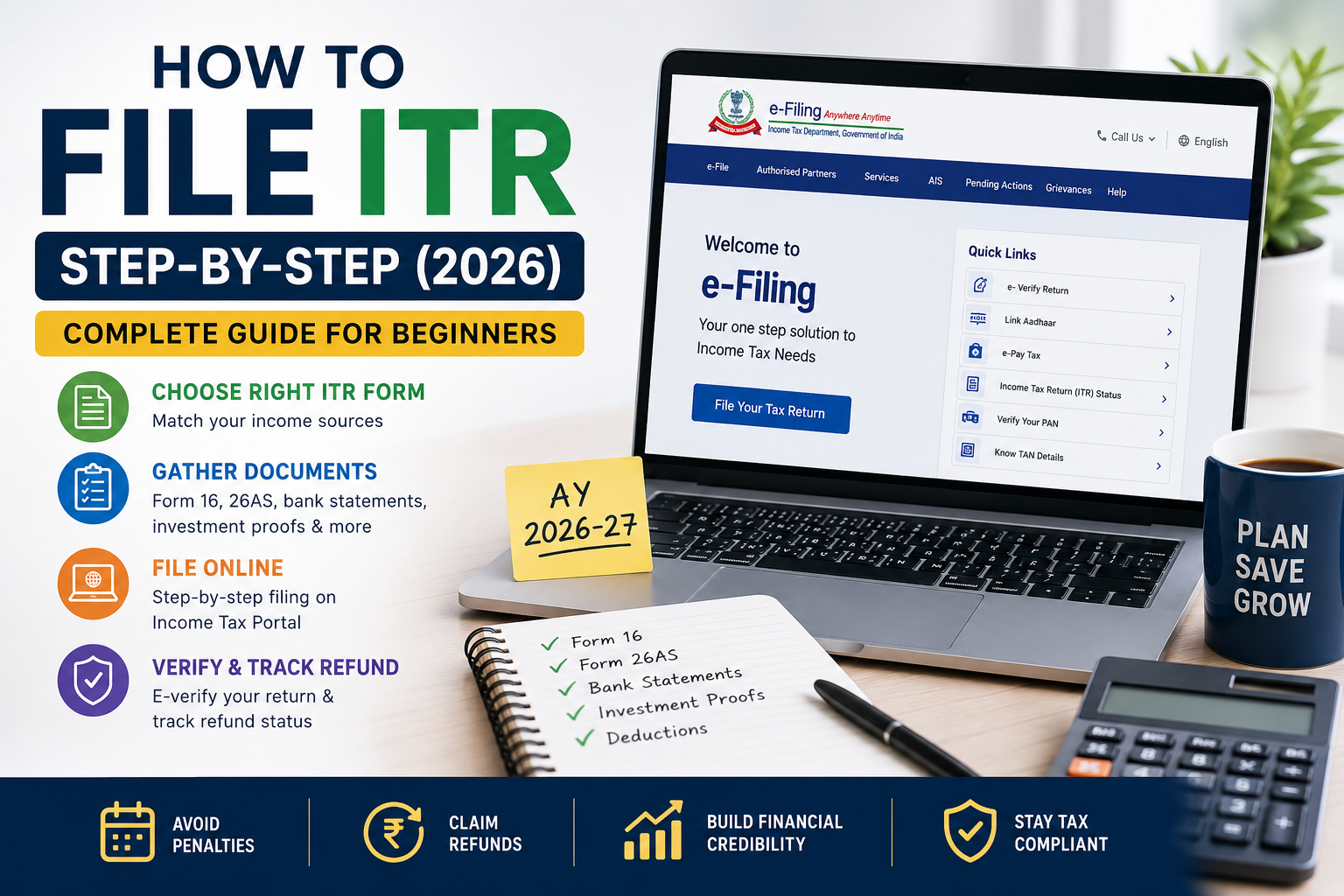
How to File ITR Step-by-Step (2026)
Filing your Income Tax Return (ITR) may sound complicated, but once you understand the process, it becomes much easier and stress-free. Whether you're a salaried employee, freelancer, or small business owner, filing your ITR correctly for Assessment Year 2026–27 is important not only for tax compliance but also for maintaining a strong financial record.
- A properly filed ITR helps you:
- Claim tax refunds faster
- Avoid penalties and notices
- Improve loan and credit card eligibility
- Maintain financial credibility for visas and investments
- Carry forward losses for future tax benefits
In this step-by-step guide, you’ll learn everything you need to know about filing your ITR online in a simple and practical way.
Step 1: Understand the Financial Year and Assessment Year
Before filing your return, it’s important to understand these two terms:
- Financial Year (FY 2025–26): The year in which you earned your income
- Assessment Year (AY 2026–27): The year in which that income is assessed and taxed
For example, income earned between 1 April 2025 and 31 March 2026 will be filed in AY 2026–27.
Step 2: Collect All Required Documents
The most important part of smooth ITR filing is keeping your financial documents ready beforehand. Proper documentation reduces mistakes and helps you claim all eligible deductions.
Important Documents You Need
Form 16
If you are salaried, your employer provides Form 16, which contains:
- Salary details
- Tax deducted at source (TDS)
- Employer information
If you changed jobs during the financial year, collect Form 16 from all employers.
Form 26AS
Form 26AS shows:
- TDS deducted
- Tax payments
- Refund details
- High-value transactions
Always verify that your TDS matches your salary slips and bank records.
Bank Statements & Interest Certificates
Collect details for:
- Savings account interest
- Fixed deposit interest
- Recurring deposits
- Post office deposits
Remember, interest income is taxable.
Investment Proofs
Keep records for deductions under:
- Section 80C (PPF, ELSS, LIC, etc.)
- Section 80D (Health insurance)
- Home loan interest
- Donations under 80G
Capital Gains Reports
If you sold:
- Shares
- Mutual funds
- Property
- Cryptocurrency
Then collect capital gains statements from brokers or platforms.
Step 3: Choose the Correct ITR Form
Selecting the correct ITR form is extremely important. Filing the wrong form can make your return defective or invalid.
Common ITR Forms
| ITR Form | Suitable For |
|---|---|
| ITR-1 (Sahaj) | Salary income, one house property, interest income |
| ITR-2 | Capital gains, foreign assets, multiple properties |
| ITR-3 | Business or professional income |
| ITR-4 (Sugam) | Presumptive income under Section 44AD/44ADA |
Quick Selection Guide
- Salary + simple income → ITR-1
- Stock market or property gains → ITR-2
- Freelancers/business owners → ITR-3 or ITR-4
Always check the latest eligibility rules before filing.
Step 4: Register or Log In to the Income Tax Portal
Visit the official Income Tax e-Filing portal and:
- Register using your PAN
- Verify your mobile number and email
- Log in securely using your password
Once logged in, update your:
- Personal details
- Bank account information
- Contact information
Correct bank details are important for receiving refunds smoothly
Step 5: Verify Form 26AS and AIS
Before entering your income details, compare your records with:
- Form 26AS
- Annual Information Statement (AIS)
This helps identify:
- Missing TDS entries
- Incorrect salary reporting
- Unreported income
Mismatch in tax details is one of the biggest reasons for notices and refund delays.
Step 6: Enter Your Income Details
Now fill in all your income sources carefully.
Include:
- Salary income
- Interest income
- Rental income
- Freelance income
- Capital gains
- Business income
Even small income sources should be reported properly.
Step 7: Claim Deductions and Tax Benefits
This is where you can reduce your taxable income legally.
Popular Tax Deductions
| Section | Deduction Type |
|---|---|
| 80C | PPF, ELSS, LIC, EPF |
| 80D | Health insurance |
| 80TTA | Savings account interest |
| 24B | Home loan interest |
| 80G | Donations |
Claim only genuine deductions supported by valid documents.
Step 8: Review Your Return Carefully
Before submitting:
- Check PAN and Aadhaar details
- Verify bank account numbers
- Ensure TDS matches Form 26AS
- Review deduction claims
- Confirm all income sources are included
Even a small mistake can delay processing.
Step 9: Submit Your ITR
After reviewing everything:
- Click “Submit”
- Complete e-verification immediately
E-Verification Methods
- Aadhaar OTP
- Net Banking
- Demat Account
- Bank Account EVC
Without verification, your ITR will be treated as invalid.
Step 10: Download ITR-V and Track Refund Status
After successful filing:
- Download your ITR-V acknowledgment
- Save a copy for future use
You can track your refund status using your acknowledgment number through the portal.
Common ITR Filing Mistakes to Avoid
Many taxpayers make simple mistakes that lead to notices or delayed refunds.
Avoid These Errors:
- Entering incorrect PAN details
- Filing the wrong ITR form
- Not reporting all income sources
- Ignoring Form 26AS mismatches
- Forgetting e-verification
- Providing incorrect bank details
- Missing schedules for foreign assets or exempt income
Careful review can save you from future complications.
Why Filing ITR on Time Matters
Timely ITR filing offers long-term financial benefits beyond tax compliance.
Benefits of Timely ITR Filing
- Faster refunds
- Better loan approval chances
- Easier visa applications
- Strong financial history
- Avoidance of penalties and interest
- Easier investment tracking
A consistent ITR record builds trust with banks and financial institutions.
Final Thoughts
Filing your Income Tax Return in 2026 doesn’t have to be confusing. By organizing your documents, choosing the correct ITR form, and carefully reviewing your details, you can complete the process smoothly and confidently.
Start early, avoid last-minute filing pressure, and maintain proper financial records throughout the year. If your tax situation involves multiple income sources, capital gains, or business income, consulting a qualified tax professional can help ensure complete accuracy.
A properly filed ITR is not just a legal requirement—it’s an important step toward a stronger financial future.