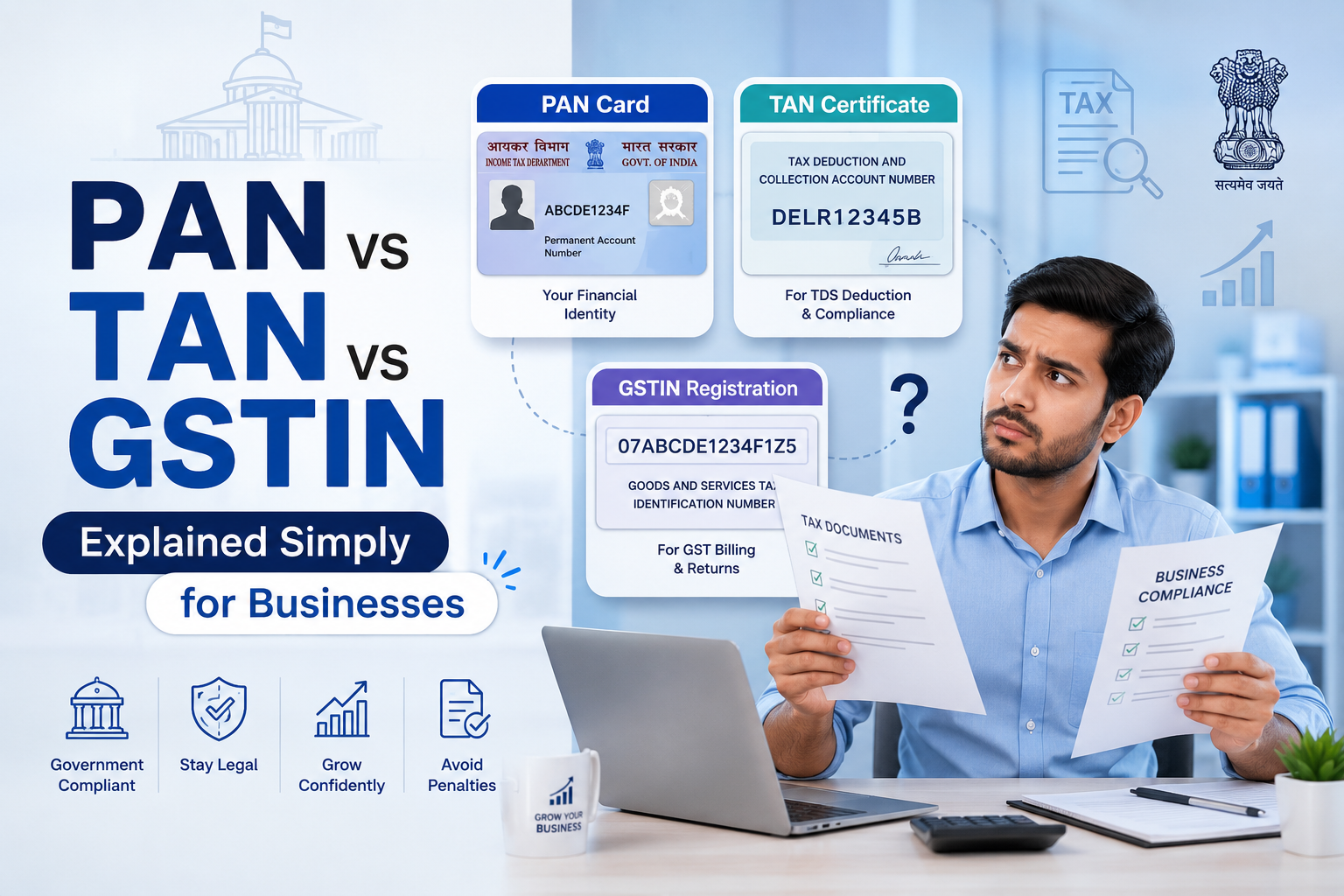
What is PAN, TAN & GSTIN? Explained in Simple and Easy Language
If you run a business in India—or are planning to start one—you’ve probably heard terms like PAN, TAN, and GSTIN. At first, these tax-related terms may sound confusing, especially for beginners, freelancers, or small business owners. But don’t worry. Once you understand their purpose, they are actually quite simple.
Think of these numbers as your business identity cards for different tax purposes. The government uses them to track income, taxes, and business transactions in a proper and organized way.
In this guide, we’ll explain PAN, TAN, and GSTIN in the easiest possible language, along with examples, benefits, and when you actually need them.
What is PAN?
PAN stands for Permanent Account Number. It is a unique 10-character alphanumeric code issued by the Income Tax Department of India.
Example of PAN: ABCDE1234F
You can think of PAN as your financial identity number. It helps the government track your income, taxes, and major financial transactions.
Whether you are a salaried employee, freelancer, shop owner, startup founder, or company owner, PAN is extremely important.
Why is PAN Important?
You need PAN for many financial activities such as:
- Filing Income Tax Returns (ITR)
- Opening a bank account
- Applying for loans or credit cards
- Buying or selling property
- Investing in shares or mutual funds
- Receiving large payments
- Starting a business
Without PAN, many financial activities become difficult or may attract higher tax deductions.
Structure of PAN
PAN contains 10 characters:
- First 5 characters → Alphabets
- Next 4 characters → Numbers
- Last character → Alphabet
Example: ABCDE1234F
Each PAN is unique. No two individuals or businesses can have the same PAN number.
Who Should Apply for PAN?
Almost everyone earning income should have a PAN, including:
- Salaried employees
- Freelancers
- Shopkeepers
- Business owners
- Companies
- Partnership firms
- Trusts and NGOs
Even students can apply for PAN if they need it for banking or investments.
What is TAN?
TAN stands for Tax Deduction and Collection Account Number.
This number is required when a business deducts tax while making payments to others. These taxes are known as TDS (Tax Deducted at Source).
Example of TAN: DELR12345B
When Do You Need TAN?
You need TAN if your business:
- Pays salaries to employees and deducts TDS
- Pays contractors or freelancers after deducting tax
- Pays rent, commission, or professional fees with TDS deduction
Simple Example
Suppose your company pays a freelancer ₹50,000 for a project.
According to tax rules, you may need to deduct 10% TDS before making payment.
So:
- Freelancer invoice = ₹50,000
- TDS deducted = ₹5,000
- Amount paid = ₹45,000
The deducted ₹5,000 must be deposited with the government using your TAN.
Without TAN, you cannot file TDS returns properly.
Why is TAN Important?
TAN is necessary for:
- Filing TDS returns
- Depositing deducted taxes
- Generating TDS certificates
- Avoiding penalties from the Income Tax Department
If you deduct TDS without TAN, the government may charge penalties.
What is GSTIN?
GSTIN stands for Goods and Services Tax Identification Number.
It is a unique 15-digit number issued to businesses registered under GST (Goods and Services Tax).
Example of GSTIN: 07ABCDE1234F1Z5
GSTIN acts as the identity number of your business under the GST system.
When Do You Need GSTIN?
You generally need GST registration if:
- Your annual turnover exceeds the government limit
- You sell products or services across different states
- You sell online through platforms like Amazon or Flipkart
- You want to claim Input Tax Credit (ITC)
- Your customers require GST invoices
GST Turnover Limits
For most businesses:
- ₹40 lakh turnover limit for goods businesses
- ₹20 lakh turnover limit for service businesses
(Some states have different limits.)
What Does GSTIN Help You With?
GSTIN helps businesses:
- Issue GST-compliant invoices
- Collect GST from customers
- File GST returns
- Claim Input Tax Credit
- Buy from registered suppliers
- Build trust with customers and vendors
A GST-registered business usually looks more professional and trustworthy.
Understanding GSTIN Structure
A GSTIN has 15 characters.
Example: 07ABCDE1234F1Z5
Breakdown:
- First 2 digits → State code
- Next 10 digits → PAN number
- 13th digit → Entity number
- 14th digit → Usually “Z”
- 15th digit → Check code
Interesting fact:
The first 10 digits of GSTIN are actually your PAN number. This helps connect GST records with income tax records.
Key Difference Between PAN, TAN & GSTIN
| Feature | PAN | TAN | GSTIN |
|---|---|---|---|
| Full Form | Permanent Account Number | Tax Deduction and Collection Account Number | Goods and Services Tax Identification Number |
| Issued By | Income Tax Department | Income Tax Department | GST Department |
| Number of Digits | 10 | 10 | 15 |
| Who Needs It | Everyone earning income | Businesses deducting TDS | GST-registered businesses |
| Main Purpose | Income tax & financial identity | TDS deduction and filing | GST billing and tax filing |
Do You Need All Three?
Not always.
Here’s a simple breakdown:
- PAN → Required for almost everyone
- TAN → Needed only if you deduct TDS
- GSTIN → Needed only if your business falls under GST rules
Example Scenarios
Example 1: Freelancer
A freelance graphic designer earning ₹8 lakh annually may need:
- PAN → Yes
- TAN → No
- GSTIN → Possibly yes (depending on turnover and clients)
Example 2: Small Shop Owner
A local grocery shop with ₹15 lakh turnover may need:
- PAN → Yes
- TAN → No
- GSTIN → Maybe not mandatory
Example 3: Private Company
A company with employees and interstate sales may need:
- PAN → Yes
- TAN → Yes
- GSTIN → Yes
How to Apply for PAN, TAN & GSTIN
PAN Application
You can apply online through:
Documents Required
- Aadhaar Card
- Address proof
- Passport-size photo
TAN Application
You can apply through:
- Protean eGov TAN Services
Documents Required
- Business proof
- PAN details
- Address proof
GSTIN Application
Apply through the official GST portal:
Documents Required
- PAN card
- Aadhaar card
- Business address proof
- Bank account details
- Business registration documents
How Long Does Approval Take?
| Registration | Estimated Time |
|---|---|
| PAN | 10–15 days |
| TAN | 7–15 days |
| GSTIN | 7–10 working days |
Sometimes approval may come faster if all documents are correct.
What Happens If You Don’t Have Them?
Ignoring these registrations can create problems such as:
- Penalties from tax departments
- Difficulty filing taxes
- Problems opening business bank accounts
- Delays in refunds
- Legal notices
- Trouble working with large companies
Many businesses and clients prefer working only with properly registered entities.
Common Mistakes to Avoid
1. Wrong PAN in GST Registration
A small typing mistake can create verification issues.
2. Not Updating Business Details
If your address or business name changes, update records immediately.
3. Missing TDS Filing Deadlines
Late filing can result in penalties and interest.
4. Using Wrong GSTIN on Invoices
Always verify GST numbers before printing invoices.
Final Thoughts
PAN, TAN, and GSTIN may look like complicated tax terms, but they are simply tools that help businesses operate legally and smoothly in India.
- PAN helps track your income and taxes.
- TAN helps manage TDS deductions.
- GSTIN helps businesses collect and pay GST properly.
Whether you are a freelancer, startup owner, shopkeeper, or growing company, understanding these numbers is an important step toward building a professional and compliant business.
Pro Tip:
Always double-check these numbers on invoices, returns, and official forms. Even a small error can lead to notices, penalties, or delays later.
Stay informed. Stay compliant. Grow your business with confidence.