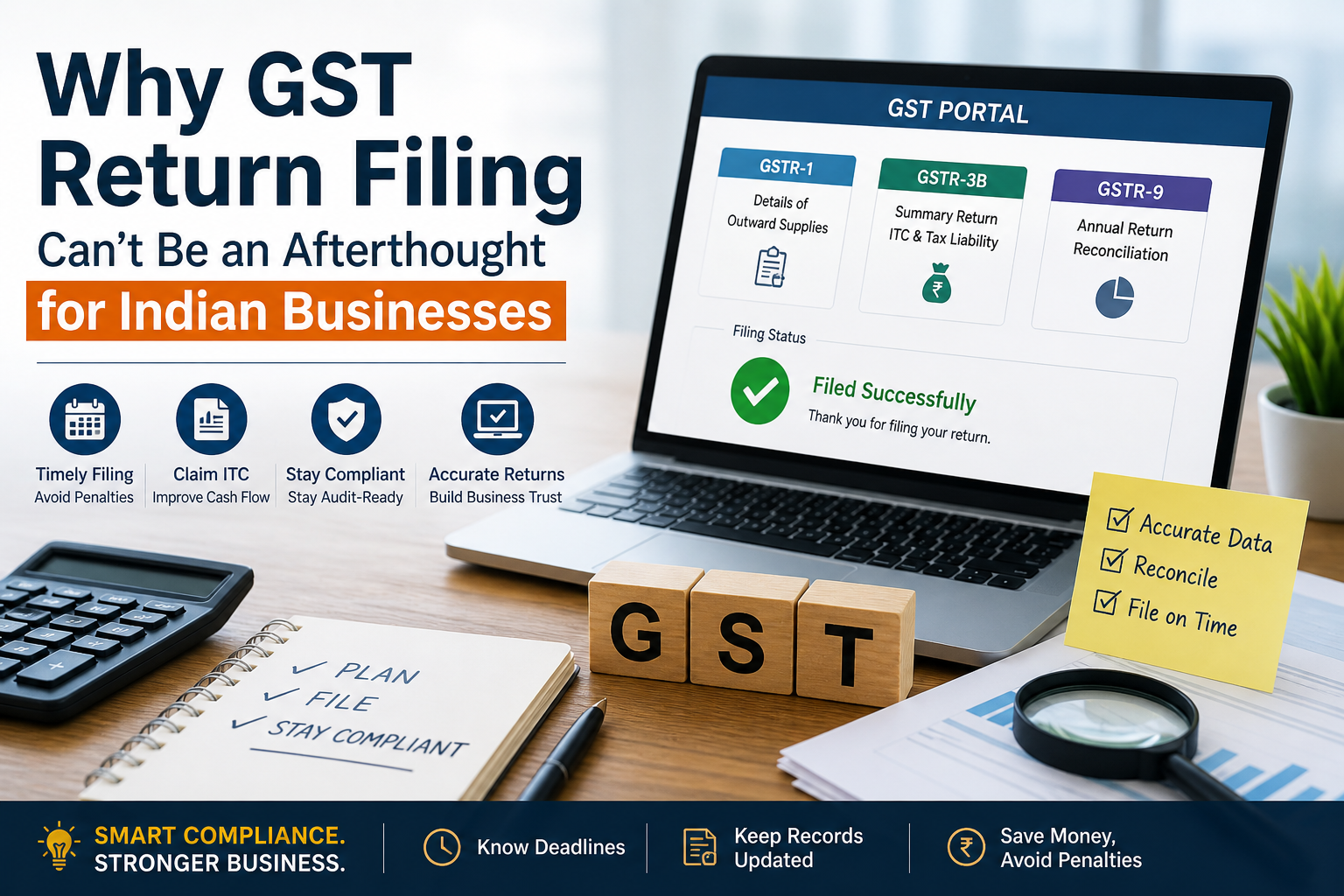
Why GST Return Filing Should Never Be a Last-Minute Task for Businesses
Running a business in India already comes with enough responsibilities—managing sales, handling customers, paying vendors, and keeping cash flow under control. In the middle of all this, many businesses treat GST return filing as something they can “do later.” Unfortunately, that small delay often turns into penalties, blocked Input Tax Credit (ITC), or even notices from the GST department.
Whether you own a retail shop, provide professional services, or run an online business, GST filing is not just a legal formality anymore. It directly affects your financial health, business reputation, and day-to-day operations.
Today, the GST system is highly automated. Invoice mismatches are tracked quickly, and even small mistakes can create problems. That’s why businesses should treat GST compliance as a regular financial activity rather than a stressful month-end task.
Why GST Filing Matters More Than Ever
Many business owners believe GST filing is only about paying taxes on time. In reality, it does much more than that.
Accurate GST filing helps businesses:
- Claim proper Input Tax Credit (ITC)
- Avoid unnecessary penalties and interest
- Maintain smooth cash flow
- Stay prepared for audits
- Build trust with vendors and customers
Prevent GST notices and compliance issues
For example, if a supplier uploads incorrect invoice details or delays filing their return, your ITC may get blocked temporarily. This can affect your working capital and increase your financial burden.
Businesses in growing commercial cities like Delhi, Noida, Bengaluru, Mumbai, and Jaipur are increasingly using digital accounting systems to reduce such errors and keep records organized.
Understanding the Main GST Returns
GST returns may look complicated in the beginning, but once you understand the purpose of each form, the process becomes much simpler.
GSTR-1 – Sales Return
GSTR-1 is used to report all outward supplies or sales made during a month or quarter.
This includes:
- B2B invoices
- B2C sales
- Credit and debit notes
Export details
Even if there are no sales in a particular period, businesses still need to file a Nil Return.
Example:
Suppose your company sold products worth ₹5 lakh during the month. All those invoices must be reported in GSTR-1 with correct GSTIN details and HSN codes.
GSTR-3B – Summary Return
GSTR-3B is a monthly summary return where businesses:
- Declare tax liability
- Claim Input Tax Credit
- Pay GST dues
This is one of the most important returns because incorrect filing can directly impact your tax credit eligibility.
Example:
If you paid GST on office purchases or business expenses, you can claim ITC through GSTR-3B, provided the invoices are valid and uploaded correctly by suppliers.
GSTR-9 – Annual Return
GSTR-9 is the yearly summary of all GST transactions.
It helps businesses reconcile:
- Sales
- Purchases
- Tax paid
- ITC claimed
Think of it as a final yearly check to ensure all monthly returns were filed accurately.
Step-by-Step GST Return Filing Process
Many small business owners feel nervous while filing GST returns online. But the process becomes easy when followed step-by-step.
Step 1: Login to GST Portal
Visit the official GST portal and login using your:
- GSTIN
- Username
- Password
Make sure your registered mobile number and email ID are active.
Step 2: Open Return Dashboard
Go to:
Services → Returns → Return Dashboard
- Select:
- Financial year
- Return filing period
Step 3: Upload Sales Details in GSTR-1
Add all invoice details carefully, including:
- Invoice number
- GSTIN
- Tax amount
- HSN/SAC code
Small mistakes in invoice matching can create ITC issues for customers.
Step 4: File GSTR-3B
Enter:
- Total sales
- Tax payable
- ITC claimed
Before filing, compare your purchase records with GSTR-2A or GSTR-2B.
Step 5: Pay Tax Liability
If any GST amount is payable, generate a challan and pay using:
- Net banking
- UPI
- NEFT
- Debit/Credit card
Step 6: Submit and Verify
Finally, submit the return using:
- EVC (Electronic Verification Code)
or - DSC (Digital Signature Certificate)
Once filed successfully, keep the acknowledgement safely for future reference.
Common GST Filing Mistakes Businesses Should Avoid
Even experienced businesses make mistakes while filing GST returns. Some errors may look small but can create major compliance issues later.
1. Not Reconciling GSTR-2A with Books
One of the most common mistakes is failing to match purchase records with supplier-uploaded invoices.
This can lead to:
- ITC rejection
- Tax notices
- Financial mismatches
Tip:
Always reconcile records monthly instead of waiting until year-end.
2. Wrong HSN or SAC Codes
Incorrect classification of goods or services may result in:
- Wrong tax rates
- Notices
- Filing mismatches
Businesses working in multiple industries should be extra careful.
3. Late Filing
Late GST filing leads to:
- Interest charges
- Late fees
- Compliance risk
It may also affect vendor relationships if customers cannot claim ITC on time.
4. Claiming ITC on Personal Expenses
Input Tax Credit can only be claimed for business-related expenses.
Wrong Examples:
- Personal shopping
- Family travel expenses
- Personal vehicle usage
Correct Examples:
- Office rent
- Business software
- Professional services
5. Ignoring Nil Returns
Even if there are no transactions, GST returns must still be filed.
Missing Nil Returns can also attract penalties.
Simple Tips to Make GST Filing Easier
Here are some practical ways businesses can simplify GST compliance:
Maintain Digital Records
Use accounting software to store invoices and reports safely.
File Monthly
Avoid piling up work at the end of the financial year.
Verify GSTINs
Always check customer and supplier GST numbers before invoicing.
Automate Reconciliation
Modern software can automatically match invoices and reduce manual errors.
Take Professional Help
If GST feels confusing, consult a qualified accountant or GST expert.
Final Thoughts
GST compliance may seem stressful initially, but with proper planning and regular filing habits, it becomes much easier to manage.
Businesses that stay organized:
- Avoid penalties
- Maintain better cash flow
- Build stronger financial credibility
- Stay audit-ready
Instead of treating GST filing as a last-minute burden, businesses should view it as an important part of financial discipline and long-term growth.
A few simple habits—timely filing, accurate invoicing, and regular reconciliation—can save both money and stress in the future.